



Most businesses still treat cyber security like an IT problem. That’s how breaches happen. But cyber threats are now a matter of when, not if.
Attackers move faster than most businesses can adapt. Businesses are therefore reactive by default, not by design.
For large enterprises, the attack surface is huge: thousands of endpoints, multi-cloud deployments, hybrid workforces, third-party vendors, and legacy systems that clash with modern infrastructure.
That’s why cyber security services are now so strategically important.
This blog provides a comprehensive guide to securing your enterprise.
We will explore:
- What cyber security services include.
- The threats most relevant to enterprises today.
- Common cyber threats facing enterprises.
- Cyber security solutions for modern enterprises.
- Challenges for enterprise security leaders.
You’ll walk away with a clearer idea of what strong security actually looks like.
Want to uncover the vulnerabilities in your security? Learn more about security audits: What Are Cyber Security Audits, and Are They Really Important?
Cyber Security Services: What You Might Be Overlooking
Cyber security services are all about protecting your systems, data, and networks from unauthorised access, disruption, or damage.
But it’s not just about tech: it’s about how people, tools, and processes work together to reduce risk and respond fast when something goes wrong.
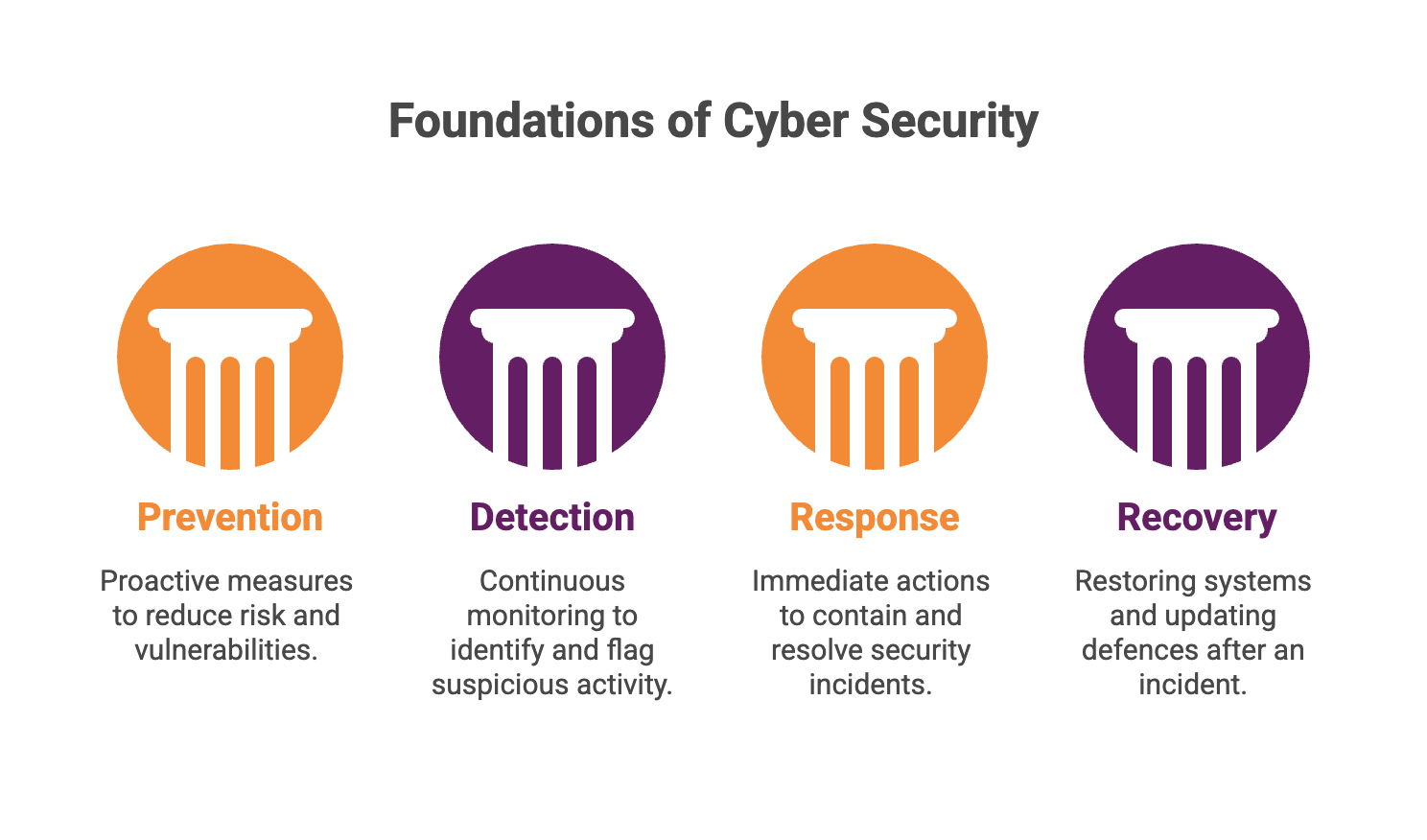
Key pillars of cyber security services include:
- Prevention: Proactive steps to reduce risk, like vulnerability management, firewalls, encryption, and employee training.
- Detection: Keeping eyes on the environment around the clock to flag suspicious activity as it happens.
- Response: Taking immediate action to contain threats, isolate systems, and fix the issue before it spreads.
- Recovery: Restoring systems, analysing incidents, and updating defences to prevent repeats, to ensure business continuity.
Some organisations try to cover all this internally. But even with a capable IT team, the workload, round-the-clock coverage, and specialist knowledge needed is difficult to achieve in-house. You’ll need both tools and a strategy.
Why Cyber Security Is Critical for Large Enterprises
Enterprises are no longer confined to a single office or a handful of servers. Today, they operate globally, with a complex ecosystem that includes:
- Cloud platforms: Centralised resources and data that, if misconfigured, can be accessed by attackers.
- SaaS applications: Business-critical apps that often store sensitive data and can be targeted through phishing or credential theft.
- Mobile devices: Laptops, tablets, and smartphones that connect remotely and may be lost, stolen, or compromised by malware.
- Third-party vendors: External partners who access enterprise systems, introducing additional potential vulnerabilities.
Managing all of this in-house is difficult. It’s not just about having the right tools, but the time, expertise, and visibility to use them properly.
That’s where Managed Service Providers (MSPs) and Managed Security Service Providers (MSSPs) come in. They deliver cyber security services as an ongoing function, covering everything from endpoint protection to threat detection, compliance, and incident response.
For large enterprises, this complexity in architecture – spanning legacy systems, cloud services, mobile endpoints, and third-party access – also expands the attack surface: the total number of potential entry points an attacker can exploit.
Common Cyber Threats Facing Enterprises
1. Phishing and Social Engineering
Phishing is still one of the most effective ways attackers get inside enterprise environments. In fact, it accounts for 36% of breaches in 2025, according to Verizon’s 2025 Data Breach Investigations Report. Phishing tricks employees into sharing credentials or downloading malware.
What makes phishing so dangerous is how easily it adapts to different environments and targets:
- Spear phishing: Tailored attacks are aimed at executives, using personal or company info to make messages look legitimate.
- Business Email Compromise (BEC): Attackers impersonate vendors, partners, or internal staff to trick employees into transferring money or sharing access.
- Smishing and vishing: SMS and voice-based phishing that targets employees on mobile devices, often outside standard security controls.
Not all phishing starts with an email. For example, the 2023 MGM Resorts breach began with a 10-minute phone call to the IT helpdesk, where attackers posed as an employee to gain credentials.
See what’s next on the threat radar: Cyber security threats that will target networks in 2025.
2. Supply Chain Attacks
Enterprises require vendors, cloud providers, and third-party software. Attackers exploit this reliance by targeting weaker links in the supply chain.
Examples of supply chain risks:
- Compromised software updates: Attackers inject malware into legitimate updates, allowing them to spread malicious code through trusted delivery channels.
- Data exposure from third-party SaaS breaches: Apps your team relies on are compromised, and customer data stored in those platforms is leaked.
- Hardware-level vulnerabilities: Flaws built into physical components like chips or firmware that attackers can exploit once devices are in use.
A high-profile example is the Kaseya VSA ransomware attack, where threat actors compromised a remote management tool used by MSPs. They managed to affect more than 1000 downstream businesses across the globe.
For practical steps to harden your IT environment, read: How to protect your IT infrastructure.
3. Cloud Security Risks
Cloud use is near-universal – and misconfigurations are a top cause of breaches.
Gartner predicts that by 2025, 99% of cloud security failures will be the customer’s responsibility, often stemming from mismanaged identities or permissions.
Cloud-specific threats include:
- Overly broad user access permissions: Employees or contractors are given more access than needed, making it easier for attackers to move through systems if they gain access to a compromised account.
- Data exposure from shadow IT applications: Employees use unsanctioned apps or services without IT approval, sensitive data can be stored or shared insecurely.
As an example, in 2022, Uber suffered a major breach after an attacker gained access to internal systems via stolen credentials from a third-party contractor.
To learn more about cloud security risks, you can talk to a cloud expert.
Cyber Security Services for Modern Enterprises
Enterprises can’t rely on a single platform, policy, or piece of software to stay secure. Modern environments are complex, with threats spanning networks, devices, cloud workloads, and user access.
The core cyber security services delivered by a Managed Security Services Provider (MSSP) aren’t siloed. They overlap and reinforce each other, creating a stronger, integrated framework that reduces the risk of exploitable gaps.
Below are eight core cyber security services that form the backbone of a strong enterprise security strategy.
1. Network Security
Network security is a managed service that protects everything flowing through your enterprise network.
It ranges from on-prem (systems hosted within the organisation, rather than in the cloud) to remote connections and cloud-based systems.
This service prevents unauthorised access to internal systems, protects data while it’s moving between devices or locations, and defends against external attacks targeting internet-facing services, such as web portals, email servers, or public APIs.
- Firewalls (hardware and cloud-based)
- Intrusion Detection and Prevention Systems (IDS/IPS)
- Network segmentation and micro-segmentation
- Virtual Private Networks (VPNs)
- Secure traffic monitoring and logging tools
A strong network security service gives you visibility and control over how data moves through your environment. It’s your first line of defence against intrusions.
2. Endpoint Security
Endpoint security is a service focused on protecting every device that connects to your network. It covers items ranging from employee laptops and desktops to mobile phones and tablets.
A managed service provider configures and maintains Endpoint Detection and Response (EDR) tools, ensuring devices are constantly monitored and remain compliant with security policies.
It helps protect against malware, ransomware, and unauthorised access to corporate data stored on local devices. This includes endpoints used by remote staff or third-party contractors.
- EDR tools, such as CrowdStrike or Microsoft Defender for Endpoint
- Antivirus and anti-malware software
- Mobile Device Management (MDM)
- Patch management and device hardening
Most cyberattacks start at the device level. Managing endpoint security means threats can be stopped early, before they move through your network.
Find out how endpoint risks grow in a hybrid workforce: What is Hybrid Cloud and Does Your Business Need It?
3. Cloud Security
Cloud security is a managed service that protects your workloads, applications, and data across cloud environments such as Amazon Web Services (AWS), Microsoft Azure, and Google Cloud.
It ensures cloud infrastructure is properly configured, monitored, and integrated with your broader security operations.
This service reduces the risk of exposed data, insecure APIs (Application Programming Interfaces), and over-permissioned accounts. It also supports regulatory compliance and reduces the likelihood of misconfigurations that can leave sensitive data publicly accessible.
- Cloud Access Security Brokers (CASBs)
- Cloud Workload Protection Platforms (CWPP)
- Identity and Access Management (IAM) for cloud environments
- Data encryption and tokenisation
- Security Information and Event Management (SIEM) integration for cloud environments
Cloud systems are found everywhere in business operations now. Managed cloud security ensures they stay protected.
For more on cloud security risks and responsibilities, see: How to protect your IT infrastructure.
4. Access Management
Access management is a service that controls how users interact with your systems. That means who has access to what, how they get it, and how that access is revoked when it’s no longer needed.
It reduces the risk of unauthorised access, whether through compromised credentials or internal misuse. It helps enforce security policies across cloud apps, internal tools, and critical infrastructure.
- IAM platforms
- Multi-Factor Authentication (MFA)
- Single Sign-On (SSO)
- Privileged Access Management (PAM)
- Role-Based Access Control (RBAC)
Access is often the point of entry in a breach. A managed access service helps prevent attackers from moving freely if they compromise an account.
5. Managed Detection and Response (MDR)
MDR is a service that provides 24/7 monitoring, threat detection, and active response across your infrastructure.
It gives businesses the ability to detect suspicious activity quickly and act before it turns into a breach.
This service covers your network, endpoints, and cloud environments. It protects sensitive data and business operations by detecting and containing threats early in the attack lifecycle.
- Security Operations Centre (SOC)
- SIEM platforms
- EDR tools
- Automated alerting and response workflows
MDR gives you expert-level monitoring and response without the overhead of having to build your own 24/7 team.
Want to know why many businesses outsource this? Read: Why businesses should partner with managed service providers.
6. Incident Response
Incident response management prepares your organisation for a breach and provides expert, people-led support when one occurs.
Once an attack is identified, the focus shifts from automated monitoring to active containment, recovery, forensic analysis, and coordination across teams.
It safeguards operations, reputation, and compliance by ensuring incidents are contained quickly. Effective response also maintains trust with clients, regulators, and stakeholders through clear communication and transparent handling of the event.
- Incident response playbooks and preparation plans
- Threat intelligence and forensic investigation tools
- Containment and recovery platforms
- Skilled response teams, PR, and communications support
Every organisation will face a security incident eventually. The difference lies in preparation and people – having trained responders, clear processes, and communication strategies in place limits damage and speeds recovery.
7. Vulnerability Management & Penetration Testing
This service involves regularly scanning your systems – ideally on a quarterly basis – for known vulnerabilities and running simulated attacks to identify weaknesses in your security posture.
It’s a critical part of maintaining visibility and control over your risk exposure.
Vulnerability assessments and penetration tests highlight gaps and weak points in software, configurations, and network architecture. The MSP then produces a report outlining the risks, their potential impact, and recommended remediation steps.
This process ensures weaknesses are addressed, compliance requirements are met, and the environment is prepared for third-party audits or certifications. It’s also an area where the MSP works more closely with clients, discussing findings and agreeing on how to strengthen defences.
- Vulnerability scanners
- Penetration testing frameworks
- Patch management
- External attack surface analysis
Hidden vulnerabilities are one of the most common paths to compromise. Regular scanning, testing, and remediation – supported by clear reporting and collaboration with your MSP – gives you a clear view of your exposure and how to reduce it.
8. Security Awareness Training
Security awareness training is a managed program designed to educate staff on common threats, risky behaviours, and how to respond to suspicious activity.
It’s delivered through simulations, workshops, and ongoing policy refreshers.
This service strengthens the human layer of security by giving employees the knowledge to recognise phishing and social engineering attempts, identify suspicious behaviour, and follow proper data handling policies.
- Phishing simulation platforms
- Interactive training modules
- Compliance training and audits
- Policy development, implementation, and communication
Human error remains the leading cause of data breaches. According to the Verizon 2023 Data Breach Investigations Report, 74% of breaches in 2023 involved the human element. This included errors, privilege misuse, stolen credentials, and social engineering.
Find out more about Network Security Threats: Is Your Business Prepared?
Why Cyber Security Needs a Strategy
Cyber security is a critical function, and it therefore needs structure, clarity, and forward planning.
What a Security Strategy Actually Looks Like
- Understanding your environment and risk profile
- Mapping systems, users, and data flows
- Defining critical assets and potential attack paths
- Prioritising based on business impact and threat likelihood
From there, the focus shifts to implementation. A security strategy brings together the right services, from endpoint protection and access controls all the way to incident response and recovery.
Then it layers them into an integrated, manageable framework. Policies, processes, human oversight and monitoring must support the technical controls.
Why this matters now
A cyber security strategy matters for the same reason you follow a plan when building a house or assembling machinery. You need to know what the end result should look like, the steps to get there, and which tools are required at each stage.
Without that structure, efforts become fragmented. And gaps are what attackers look for.
Challenges for Enterprise Security Leaders
Even with large-scale budgets and advanced tools, enterprise IT leaders still face structural challenges for their security.
Technology alone isn’t the only challenge. Security leaders also have to contend with the complexity, fragmentation, and capacity constraints of their internal operations and IT environments.
Here’s where enterprise security efforts are most commonly blocked.
1. Compliance and regulatory pressures
Cyber security services provide the monitoring, reporting, and expertise enterprises need to stay compliant without exhausting internal teams.
The Privacy Act 1988 (Cth), enforced by the Office of the Australian Information Commissioner (OAIC), outlines how organisations must protect personal information, and how to respond when breaches occur.
For financial services and critical infrastructure, frameworks like the Australian Prudential Regulation Authority (APRA)’s Prudential Standard CPS 234 add further obligations.
Meeting these requirements requires time, expertise, and evidence. For many enterprises, compliance takes up as much resourcing as threat prevention.
Learn how we help enterprises like yours when Reporting Cyber-Attacks Under the Notifiable Data Breaches Scheme.
2. Tool sprawl and infrastructure complexity
Managed security services integrate disparate platforms and streamline monitoring, reducing blind spots and operational fatigue.
Most large organisations now rely on a broad mix of platforms: cloud services, legacy systems, mobile endpoints, on-prem apps, and third-party integrations. Alongside that, they’ve accumulated dozens of security tools, such as SIEM, firewalls, identity platforms, DLP, EDR, and more.
While each has a role, the result is often:
- Data silos that make incident correlation difficult
- Poor integration across hybrid and legacy systems
- Alert fatigue from too many disconnected dashboards
In many cases, the tools meant to improve security end up creating operational blind spots.
This is exactly the challenge managed security services are designed to solve. By integrating platforms, and giving teams a clearer view of their environment, they help restore control and visibility.
3. Resource constraints and the cyber security talent gap
Outsourced cyber security services give enterprises access to 24/7 expertise and coverage without the cost and strain of building large in-house teams.
The global shortage of skilled cyber professionals continues to grow. ISC2’s 2024 Cybersecurity Workforce Study estimates the shortfall at over 4 million people.
This creates pressure across the board:
- Long lead times on security projects
- High salary competition for limited talent
- Burnout in existing teams
- Gaps in 24/7 detection and response capability
Even with strong investment, many security teams are still left operating in reactive mode, which is exactly where you don’t want to be.
Next Steps: Strengthen Your Enterprise Security Strategy
Enterprise cyber security isn’t static. As environments expand across cloud, hybrid, and remote platforms, organisations need more than reactive fixes.
They need a structured, well-managed defence that scales with the business.
Platform 24 helps organisations build and execute those plans. From initial risk assessment to managed service delivery, we work with your team to create a security roadmap that’s tailored, realistic, and built to scale.
We provide enterprise-grade cyber security services tailored to organisations with complex IT environments. Our cyber security services cover every aspect of your IT environment, creating an integrated, overlapping security foundation that keeps your business compliant, resilient, and responsive.
Learn how to start planning with confidence: IT & Cyber Security Investment Guide.
Contact us today to arrange a consultation and discover how we can safeguard your enterprise.
Frequently Asked Questions
What are cyber security management services?
Cyber security services are professional offerings designed to protect an organisation’s digital assets, networks, and data from cyber threats. They include a mix of proactive and reactive measures such as continuous monitoring, threat detection, incident response, vulnerability assessments, and strategic consulting.
Why do large enterprises need managed security services?
Large enterprises face complex IT environments, thousands of endpoints, multi-cloud deployments, and constantly evolving threats. Managed security services provide expert oversight, 24/7 monitoring, and coordinated incident response to fill gaps that internal teams may struggle to cover.
How do cyber security incident response services work?
Cyber security incident response services are designed to quickly detect, contain, and remediate security incidents. When an event occurs, specialists investigate the breach, identify affected systems, and implement measures to stop the attack from spreading.
How to choose the best cyber security services company for my business?
Choosing the right cyber security consulting services starts with assessing your organisation’s specific needs, risk profile, and regulatory requirements. Look for providers with proven experience in your industry, a comprehensive service portfolio (including audits, risk assessments, and strategic planning), and a track record of delivering measurable results.