



Market research has long been a critical tool for businesses looking to understand their target audience and refine marketing strategies. Traditionally, this process involved time-consuming surveys, focus groups, and manual data analysis. But now, AI-driven technology is reshaping the way businesses gather and interpret information.
Generative AI, powered by machine learning algorithms, can analyse vast data sets, detect patterns, and even generate human-like responses. From scanning social media posts for real-time trends to automating customer feedback analysis, AI is helping businesses extract valuable insights faster than ever before.
For small and medium-sized businesses (SMBs), leveraging AI capabilities means making data-driven decisions without the high costs of traditional methods. Whether it’s optimising marketing campaigns, refining predictive analytics, or improving competitive intelligence, generative AI offers a smarter, more efficient approach to market research.
Learn more: Is AI Disrupting the Market Research Industry?
What is Generative AI?
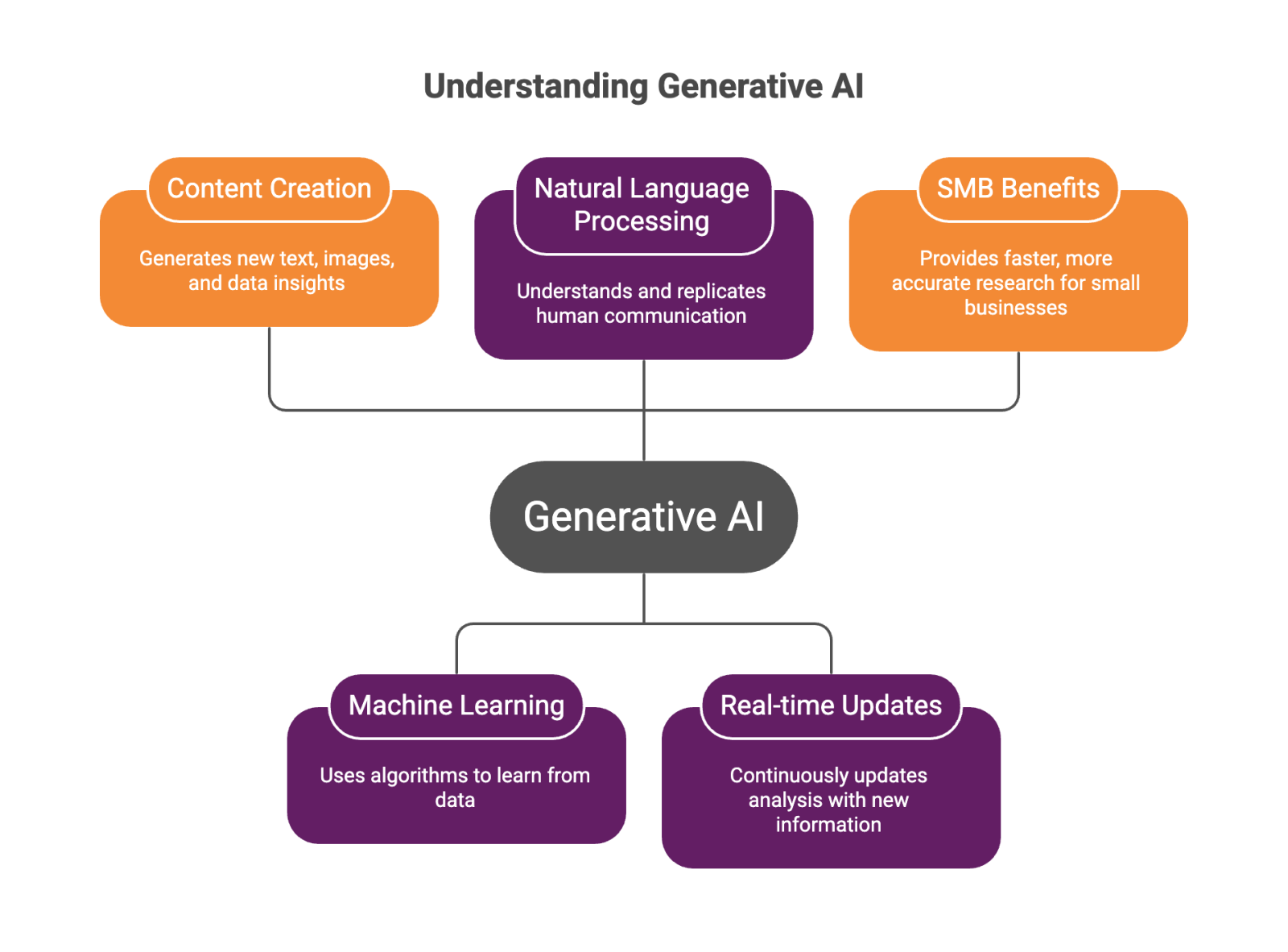
Generative AI is a type of AI technology that creates text, images, or data-based insights by recognising patterns in large data sets. Unlike basic automation tools, it doesn’t just process information—it generates new content based on existing trends and inputs.
This type of AI relies on machine learning algorithms and natural language processing (NLP) to understand and replicate human communication. It can summarise reports, analyse customer feedback, and even generate survey questions tailored to a specific target audience.
Unlike traditional methods, which often rely on static data and delayed reporting, generative AI continuously updates its analysis based on new information, such as recent social media posts or changing consumer sentiment.
For SMBs, this means faster, more accurate research without the need for large teams or costly external agencies. Instead of spending weeks sifting through data, businesses can use AI-powered tools to highlight key trends, extract actionable insights, and make informed decisions in real time.
Learn more: Generative AI vs Traditional AI: What’s the Difference?
How to Use AI for Market Research
1. Data Collection & Trend Analysis
Traditional market research requires time-consuming surveys and focus groups, but AI can instantly analyse vast data sets from multiple sources, including social media posts, online reviews, and competitor reports. With machine learning algorithms, businesses can detect emerging trends and consumer preferences before they become mainstream.
Example: An e-commerce brand can use AI to analyse customer discussions on social media, identifying trending products and adjusting its marketing campaigns accordingly.
2. Automating Survey Creation & Analysis
Generative AI can create customised surveys tailored to a business’s target audience, ensuring questions are relevant and insightful. Beyond survey creation, AI also processes responses instantly, using NLP to interpret customer feedback and highlight key patterns.
Example: A retAIl business can use AI to analyse open-ended survey responses, summarising common themes and providing actionable insights for product development.
3. Competitor & Consumer Sentiment Analysis
Understanding public perception is crucial for maintaining competitive intelligence. AI tools can scan millions of social media posts, news articles, and customer reviews to gauge how consumers feel about a brand, product, or industry trend.
Example: A hospitality business can use AI-powered predictive analytics to assess customer sentiment and adjust its service offerings accordingly.
4. Predictive Insights & Forecasting
AI doesn’t just analyse current trends; it predicts future market shifts, by use of machine learning algorithms. AI evaluates historical data and real-time information to help businesses anticipate customer needs and make informed decisions.
Example: A fashion retailer can use AI-powered forecasting tools to predict seasonal demand, ensuring it stocks the right inventory ahead of time.
5. Customer Segmentation & Personalisation
AI can categorise customers based on behaviour, demographics, and preferences, allowing businesses to tailor marketing campaigns with greater accuracy. This level of segmentation leads to more effective engagement and higher conversion rates.
Example: An online subscription service can use AI to identify different customer personas and personalise content, offers, and promotions based on user behaviour.
Learn more: The Importance of Data Analysis in Market Research
Benefits of Using Generative AI Tools for Market Research
1. Faster & More Efficient Research
Traditional market research methods, such as focus groups and manual data analysis, take weeks or even months to produce results. Generative AI can analyse vast data sets in real time, extracting valuable insights instantly.
Example: An AI tool can scan thousands of social media posts to detect emerging consumer trends within minutes, allowing businesses to adjust their marketing strategies proactively.
2. Cost Savings
Hiring research firms or conducting large-scale surveys can be expensive. AI reduces these costs by automating data collection, sentiment analysis, and report generation. Businesses can gain competitive intelligence without needing a large research team.
Example: A small business can use AI-powered tools to generate and analyse customer feedback instead of outsourcing expensive research agencies.
3. More Accurate Insights
AI minimises human error by using machine learning to detect patterns and trends that might be overlooked in traditional methods. It also ensures businesses base their decisions on concrete data rather than assumptions.
Example: AI-powered predictive analytics can help a retail business anticipate seasonal shifts in consumer demand, allowing for better stock management.
4. Better Understanding of Customers
NLP enables AI to analyse open-ended survey responses, reviews, and other unstructured data to extract deeper actionable insights. Businesses can refine their messaging, improve their products, and create more effective marketing campaigns based on real consumer sentiment.
Example: AI analysing customer feedback from product reviews can highlight key areas for improvement, leading to more customer-centric innovations.
Learn more: The Impact of Technology on Market Research
How to Overcome the Hurdles of Using Generative AI for Market Research
1. Data Privacy & Security
AI tools process large data sets, often including sensitive consumer information. Ensuring compliance with data protection laws and ethical guidelines is essential to maintaining customer trust.
Tip: Businesses should choose AI solutions that follow strict data privacy standards as laid out by the OAIC, and be transparent about data usage with their target audience.
2. Bias in AI-Generated Insights
Since AI learns from existing data, it can sometimes inherit biases present in those data sets. This can lead to skewed research findings and inaccurate recommendations.
Tip: Regularly reviewing AI-generated actionable insights and cross-checking them with human expertise can reduce bias.
3. Human Oversight is Crucial
AI can generate valuable insights, but it doesn’t replace human intuition and critical thinking. Businesses should use AI to support decision-making rather than relying on it entirely.
Tip: Combining AI tools with expert analysis ensures more balanced and informed decisions.
Next Steps: Pinpoint the Right Generative AI Tools for Market Research
Generative AI capabilities can help SMBs to transform their market research capabilities from a costly, time-consuming process into an efficient, data-driven strategy for business growth.
Platform 24 can help you integrate the best AI for market research, enabling you to extract actionable insights, refine your marketing campaigns, and make informed decisions with confidence. Reach out to our digital experts for a consultation on the best digital tools for your business operations.